
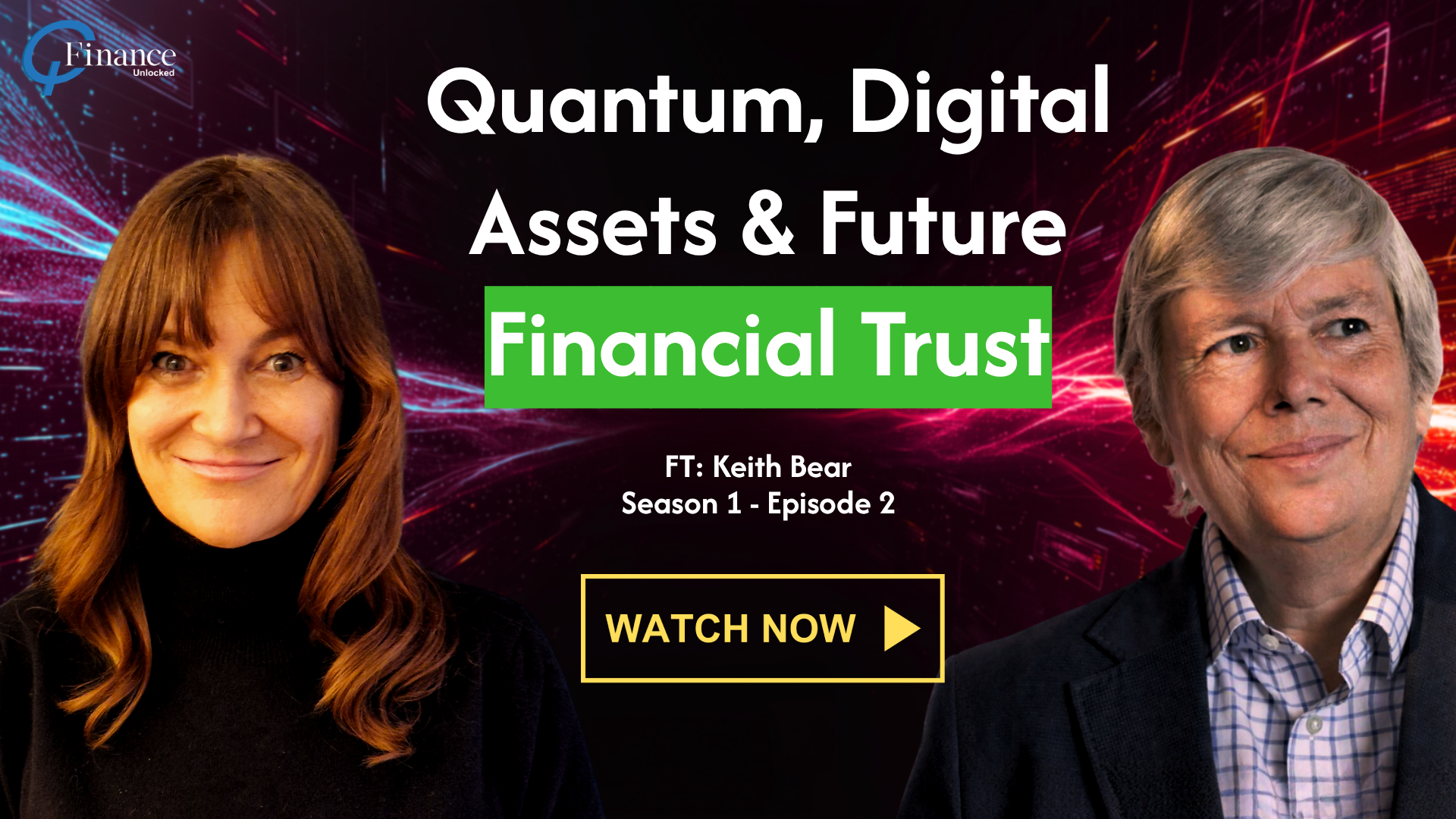
Episode 2 of Q-Finance Unlocked features Keith Bear, Chair of Research on Digital Assets at the Cambridge Centre for Alternative Finance, in conversation with Dominique Bourrat. Keith brings a rare combination of depth in theoretical physics (Oxford), hands-on quantum computing experience at IBM, and frontier research on the collision between quantum technology, blockchain, and institutional finance.
About Keith Bear
Keith Bear chairs research on digital assets at the Cambridge Centre for Alternative Finance, with a focus on the intersection of quantum computing, tokenisation, and financial infrastructure. Prior to Cambridge, Keith spent years at IBM working directly on early quantum computing programmes with major banks and financial institutions, giving him an unusually practical lens on both the hardware realities and the financial use cases that quantum unlocks.
From Feynman to Finance: Quantum Fundamentals Explained
Keith opens with a physicist's clarity on two foundational principles that underpin every quantum computer. The first is superposition, captured perfectly by Schrödinger's cat: a quantum state can be alive and dead, zero and one, or any combination simultaneously, collapsing to a definite value only when measured. This is the move from a deterministic to a probabilistic world, as Dominique frames it in the conversation.
The second is quantum entanglement: two particles, once entangled, share state instantaneously regardless of distance, what Einstein famously called "spooky action at a distance." These two principles, superposition and entanglement, translate directly into the qubit, the quantum equivalent of the classical bit, and explain why certain calculations that would take classical computers years can be resolved almost immediately on a quantum machine.
Keith illustrates this with a simple playing card demonstration: a classical computer searches through cards one at a time; a quantum computer effectively turns all four face-up simultaneously, finding the queen in a single pass.
Episode Highlights
- Quantum fundamentals for a financial audience. Superposition, entanglement, and qubits explained without the jargon
- High-value financial use cases. Portfolio optimisation, fraud detection, and Monte Carlo / Value-at-Risk calculations as prime candidates for quantum advantage
- The cryptography time bomb. Shor's algorithm, RSA exposure, and why NIST's three post-quantum cryptographic standards are the starting point for every financial institution today
- Harvest now, decrypt later. Why adversaries are already collecting encrypted data in anticipation of sufficiently powerful quantum computers
- Blockchain and tokenisation at risk. Why the decentralised governance of public blockchains makes quantum-proofing a particularly hard coordination problem
- The talent and education gap. Why the focus on quantum hardware is outpacing the software and algorithm side, and what universities need to do differently
- Hardware realities. Trapped-ion at Oxford vs. superconducting chips at IBM, and what each approach means for timelines
Keith Bear, Cambridge Centre for Alternative Finance
The Cryptography Risk Is Already Here
The episode's most urgent thread is the quantum threat to cryptography. Keith explains how Shor's algorithm, running on a sufficiently powerful quantum computer, could break RSA and ECC encryption, the backbone of financial services security, by factoring very large numbers in a fraction of the time classical machines require. NIST has already published three quantum-resistant cryptographic standards, and adoption is the critical next step.
But the danger is not only future-facing. As Dominique notes, bad actors are already harvesting encrypted data today with the intention of decrypting it once quantum hardware matures, a "harvest now, decrypt later" strategy that makes the migration to post-quantum cryptography genuinely urgent. The Global Risk Institute estimates an 18–34% probability of breaking public key encryption by 2034, rising to 60%+ by 2044.
For large financial institutions, the challenge mirrors Y2K in scale, with thousands of internal and third-party applications all requiring cryptographic migration, and the added difficulty that nobody knows the exact deadline.
Tokenisation and the Blockchain Governance Problem
Keith closes with a theme central to his research at Cambridge: the quantum vulnerability of tokenised financial markets. With roughly $3 billion in fixed-income bonds issued on blockchain infrastructure, $15 billion in global repo transactions settled on-chain, and $2 billion in tokenised investment funds, all of this growing, the exposure is real. Public blockchains like Ethereum and Solana rely heavily on elliptic curve cryptography, which is directly in the crosshairs of Shor's algorithm.
The deeper problem is governance. Unlike a SaaS vendor who can push a cryptographic update under their own control, a decentralised blockchain requires collective action from hundreds or thousands of developers worldwide. Vitalik Buterin has begun galvanising the Ethereum community, but the timeline for quantum-safe migration across the broader blockchain ecosystem remains highly uncertain. Keith's research at Cambridge, including analysis of public blockchain code repositories, finds that the vast majority of blockchain technologies in production today are not quantum-safe and show no immediate signs of becoming so.
Watch the Episode

What's Next
A future episode of Q-Finance Unlocked will go deeper on the blockchain and post-quantum cryptography intersection, with Keith's Cambridge colleague Wenbin bringing specific research on quantum-safe migration strategies for tokenised financial markets. Follow us to be notified when it drops.