
Europe has been making steady advancements in quantum integration over the past years. Governments have been committing significant amounts of public capital to quantum technologies alongside private organisations. While the main investment areas are collectively focused on quantum computing, quantum sensing, and post-quantum cryptography, the distribution of investments is far from uniform, with some nations treating quantum as a generational infrastructure priority while others are still formulating their position.
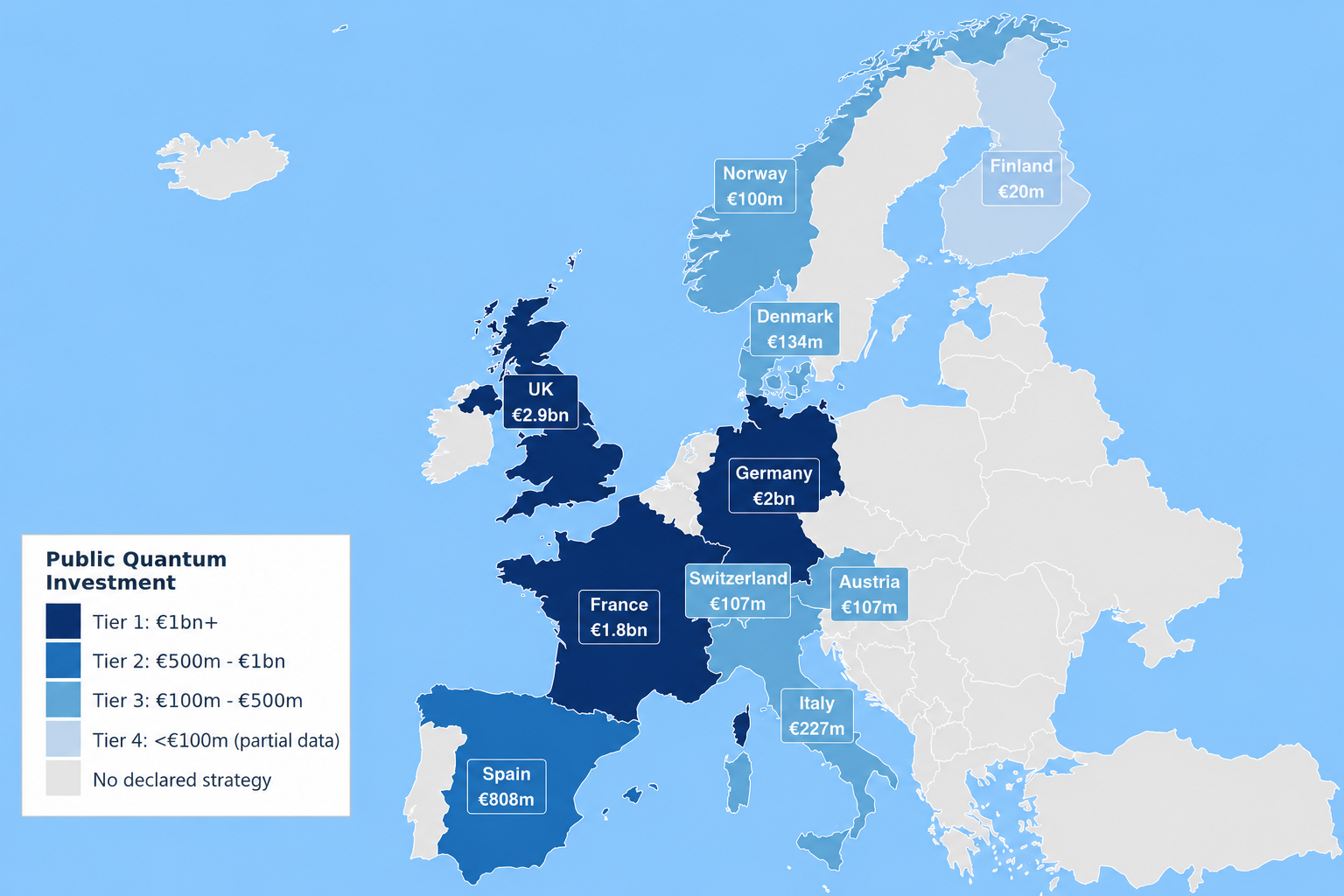
To make sense of the landscape, we have mapped confirmed government commitments across ten European countries, grouping them into investment tiers based on official sources. Grey countries on the map have no declared national quantum strategy as of Q1 2026.
Tier 1: The Billion-Euro Commitments
Three countries have crossed the billion-euro threshold in confirmed national quantum spending, setting the pace for the rest of the continent.
Germany committed over €2bn at the federal level in 2020, making it one of the earliest and largest national quantum programmes in Europe. The investment spans hardware development, software, and applications, with a significant portion channelled through the German Aerospace Center (DLR) and research institutions.
France followed in 2021 with a €1.8bn quantum plan covering the period to 2025. Announced from the Élysée, it combines public funding with private co-investment and targets full-stack capability such as chip fabrication and quantum algorithms, with French deeptech firms and national laboratories having both benefited.
The United Kingdom announced up to £2bn in its updated National Quantum Strategy in March 2026, reinforcing its ambition to be among the world's leading quantum nations. The UK programme is structured around a ten-year horizon and encompasses sensing, networking, and computing, with formal mechanisms for industry partnership and talent development.
Tier 2: Substantial Strategic Programmes (€500m–€1bn)
Spain approved an €808m national quantum strategy in April 2025 covering the period to 2030. The plan was adopted by the Council of Ministers and reflects Spain's intent to position itself as a Southern European hub for quantum research and industrial application, particularly in areas aligned with its existing aerospace and financial services sectors.
Tier 3: Focused National Investments (€100m–€500m)
Several countries have made targeted quantum commitments in the range of €100m to €250m — investments meaningful enough to build genuine national capability, though typically concentrated on one or two technology pillars.
- Italy allocated €227m through the NextGenerationEU programme for the period 2021–2024, directing funds toward quantum computing research and infrastructure in alignment with the EU's broader recovery framework.
- Denmark launched a national quantum strategy backed by 1bn DKK (approximately €134m) for the period 2023–2027. The programme has a strong focus on developing domestic quantum expertise and supporting spin-outs from Danish university research.
- Austria committed €107m through the Quantum Austria initiative, also funded in part through NextGenerationEU. Austria has a well-established quantum physics research community and their investment reflects an effort to convert academic strength into technological and commercial outputs.
- Switzerland, while not an EU member, has an estimated equivalent of approximately €107m (around CHF 102m) in aggregated quantum funding spread across the SNSF, Innosuisse, and the Swiss Quantum Initiative. This figure carries medium confidence as it is an aggregated estimate rather than a single declared programme.
- Norway announced a quantum investment of approximately €100m or more over five years, confirmed by Prime Minister Støre in August 2025. The base figure is confirmed but the full scope of the commitment may be higher as programme details are fleshed out.
Tier 4: Early-Stage Commitments
Finland has confirmed over €20m in quantum funding, anchored by the IQM/VTT partnership — a collaboration between one of Europe's leading quantum hardware companies and the national technical research centre. This figure represents partial data; total Finnish public quantum investment may be larger once additional programmatic funding is included.
What the Map Tells Us
A few observations stand out when the investment picture is viewed as a whole.
Western and Northern Europe are leading, while Central and Eastern Europe remain largely absent from declared national strategies. This is not simply a function of GDP — it reflects the degree to which quantum has been elevated to a strategic priority at government level, which in turn shapes the ecosystem conditions for private investment and talent retention.
The EU's role as a funding mechanism is significant but uneven. Several of the investments in the €100m–€250m tier are at least partially enabled by NextGenerationEU, meaning the true picture of national commitment versus supranational allocation matters when comparing programmes.
The countries that moved the earliest — Germany and France in 2020 and 2021 — are now seeing their quantum ecosystems mature in ways that later movers will struggle to replicate quickly, as the window for cost-effective catch-up is slowly closing.
Time horizons vary significantly across programmes. The UK's ten-year framing, Spain's 2025–2030 strategy, and Denmark's 2023–2027 plan each reflect different assumptions about when quantum capabilities will reach practical relevance. For financial institutions conducting their own readiness assessments, this variance matters: countries with longer-horizon programmes tend to be building for foundational research capacity, while shorter programmes often signal a focus on near-term application deployment.
Grey countries are not necessarily inactive. Some have quantum research groups operating under EU framework programmes (Horizon Europe, the Quantum Flagship initiative) without a standalone national strategy. But the absence of a declared domestic programme generally means slower ecosystem development, less private co-investment, and fewer signals for financial institutions seeking local quantum partnerships.
Implications for Financial Institutions
For banks, insurers, and asset managers assessing their own quantum exposure and readiness, the investment map is a useful big-picture proxy for where domestic quantum capability will emerge first. Regulatory expectations around post-quantum cryptography migration, quantum risk disclosure, and quantum-readiness assessments are likely to move fastest in the Tier 1 and Tier 2 markets.
Institutions operating across multiple European jurisdictions should treat this map as one input into a broader quantum readiness strategy, alongside cryptographic exposure assessments, vendor landscape reviews, and internal literacy programmes. The investment picture is dynamic, and several countries not currently on the map are in early stages of their quantum strategy development.
Data Sources
- United Kingdom: GOV.UK, National Quantum Strategy update, March 2026
- Germany: Federal Government quantum programme announcement, 2020
- France: Élysée quantum plan announcement, 2021
- Spain: Council of Ministers, national quantum strategy, April 2025
- Italy: NextGenerationEU national recovery plan, 2021–2024
- Switzerland: SNSF / Innosuisse / Swiss Quantum Initiative (aggregated estimate, medium confidence)
- Denmark: National quantum strategy, 2023–2027
- Austria: Quantum Austria / NextGenerationEU
- Norway: Prime Minister Støre announcement, August 2025 (base figure, medium confidence)
- Finland: IQM / VTT partnership announcement (partial data, medium confidence)