
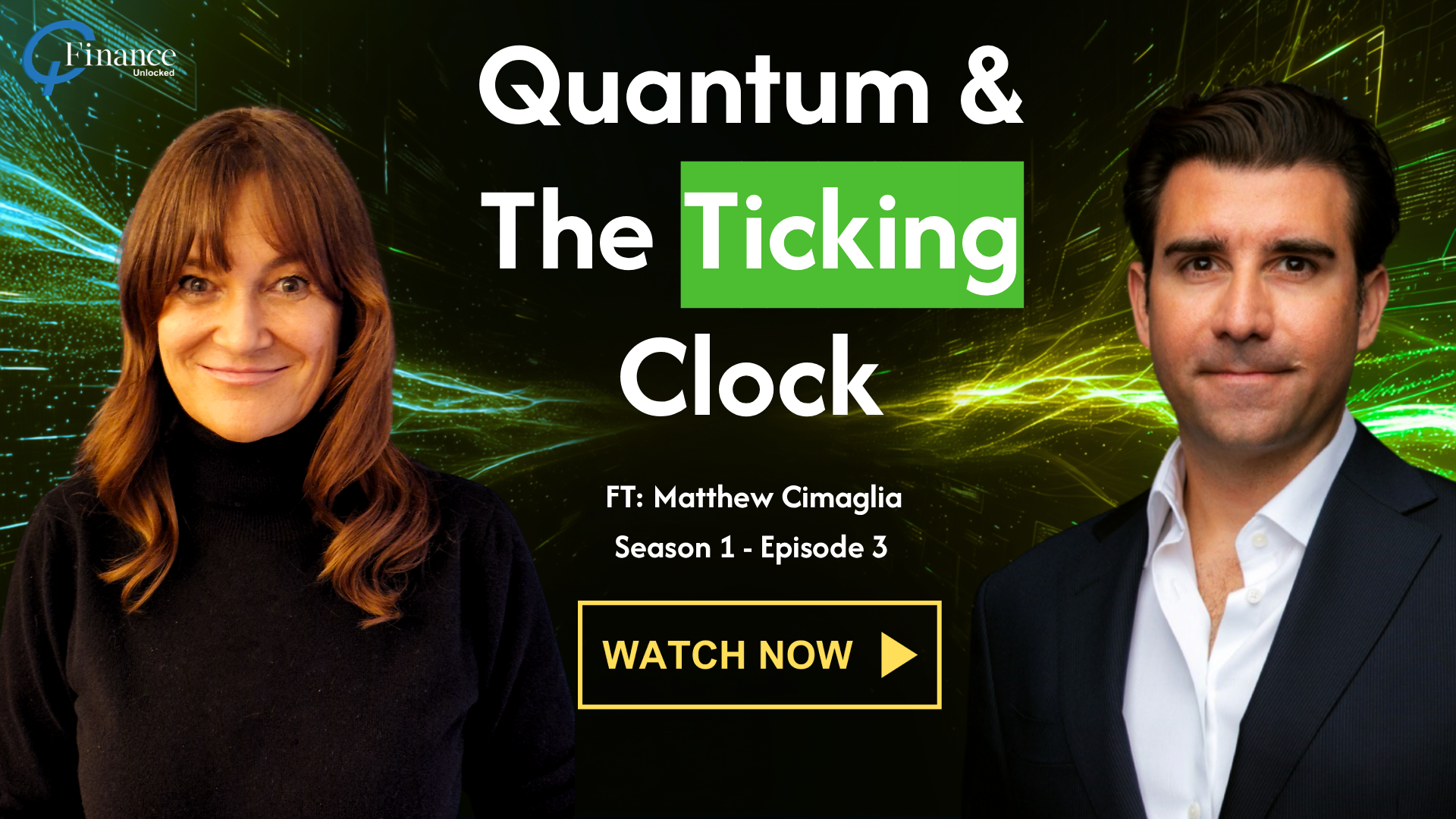
On the third episode of Q-Finance Unlocked we are joined by Matt Cimaglia, an investor, advisor, and founder of Quantum Coast Capital, a firm dedicated to translating quantum innovation into real-world commercial applications. Their conversation covers the Q-Day threat, the innovation-to-application gap, investor responsibility, and why preparation is the single greatest competitive advantage in the quantum era.
About Matt Cimaglia
Matt Cimaglia has spent the last seven to eight years immersed in the quantum ecosystem, not as a physicist, but as a communicator, strategist, and investor who bridges the gap between deep quantum science and the broader market. His background in brand strategy and creative agency work provided him with the rare vantage point of understanding how to make the intangible tangible for mainstream audiences, policymakers, and financial players alike. Through QCC, he backs early-stage quantum companies and works to build the narrative infrastructure the industry still urgently needs.
Hybrid Is The New Hype
A central theme of the conversation is Matt's framework for moving quantum from conference rooms to active deployment. One of his key insights is that quantum people spend too much of their time talking to other quantum people, leaving the general public out of the picture. Drawing on his experience, he has spent the last years focused on helping quantum companies communicate outward to non-technical audiences such as boards and regulators, in language that connects innovation to something already familiar.
Both Matt and Dominique agree that quantum will not replace existing systems but sit alongside them. The real challenge for financial institutions is identifying precisely where quantum adds advantage within hybrid architectures that blend classical computing, machine learning, generative AI, and quantum methods, while building the internal knowledge to make those distinctions confidently.
Q-Day? The Clock Is Already Ticking
The episode gives significant attention to post-quantum cryptography and the shrinking timeline to Q-Day. A recent Google report cited in the conversation suggests RSA and other widely used encryption methods could be broken as early as 2029, a timeline that has compressed considerably year on year. For board members and executives, that puts the threat squarely within a standard 3–5 year strategic planning horizon.
Matt's message is unambiguous: waiting for the threat to materialise before migrating encryption is the wrong strategy. With the ongoing risk of harvest-now, decrypt-later attacks, he stresses that migration to post-quantum cryptographic standards does not require a quantum computer. Classical systems can be updated now, and the window to do so is narrowing.
Episode Highlights
- The Q-Day timeline and why the 2029 estimate demands board-level strategic attention today
- Hybrid architecture readiness and how financial institutions should think about integrating quantum alongside AI and classical modelling
- Bridging quantum and industry and the framework for closing the communication gap through consistent, ecosystem-wide messaging
- Investment responsibility and why private capital must step into the funding void that government grants alone cannot fill
- Democratisation of quantum and the case for large institutions partnering with small, agile quantum teams rather than waiting to acquire them
- Useful, responsible, built to endure — the three criteria Matt applies to any quantum innovation worth backing
Matt Cimaglia, Investor & Advisor, QCC
The Responsibility Gap in Quantum Investment
One of the most candid exchanges in the episode centres on funding. Matt argues that too much private capital is still chasing the AI wave, leaving quantum companies chronically under-resourced. Many of the most promising teams are two to five people doing extraordinary work with very little backing. Government grants exist, but they are unreliable in timing and uncertain in outcome. His call to action is direct: investors need to treat quantum with the same seriousness and patience that the technology itself demands.
Matt draws a parallel with the early social media era, noting that Meta's acquisition of Instagram looked like a bargain in retrospect, with the same dynamic slowly forming in quantum. Large financial institutions that build internal understanding now will be better positioned to identify, acquire, and integrate the most valuable quantum teams before the window closes.
Useful, Responsible, Built to Endure
Matt's investment philosophy rests on three criteria. He argues that any quantum technology must be useful (solving a real problem), responsible (mindful of its broader human impact), and built to endure (not optimised for the next funding round, but for the next decade). He is particularly interested in quantum's potential to address large-scale challenges such as water purification, energy storage, and food security, areas where classical computing has reached its limits and quantum simulation offers a genuinely new frontier.
On responsibility, he is equally clear that democratisation matters. Quantum's benefits should not accrue only to the largest institutions that can afford early access. Supporting smaller teams, making tools accessible, and building an open ecosystem is not just ethically sound — it accelerates the entire field.
The Conversation That Matters
The quantum finance conversation still suffers from the same problem Matt identified at conferences: quantum people focus their discussions with other quantum people. This episode is a deliberate attempt to change that. Dominique brings the perspective of a board advisor who sees first-hand how few financial institutions have yet embedded quantum risk into their strategic planning. Matt brings the investor's view of what the ecosystem needs to unlock its potential.
Together, they make the case that preparation is not a cost, but one of the most durable competitive advantages available to financial institutions today. The episode is available on YouTube and Spotify. Watch Episode 3 via the player below.
Watch the Episode
